
Is Opening a Bakery Profitable? Do This Math Before You Sign a Lease
Is opening a bakery profitable? A Crumbl franchisee borrowed $269K and ended with $10K. Here's the break-even math to run before you sign a lease.

$269,109 was what they borrowed.
And all they have left is about $10,000 in equipment.
That's not a typo. That's a bankruptcy filing.
In October 2026, a Crumbl Cookies franchisee in Louisville, Kentucky filed for Chapter 7 bankruptcy.
While you may think this is all Crumbl’s fault it’s actually more of a math problem. And it’s one we see bakery owners walk into every single week, franchise or not.
If you're thinking about signing a lease, taking out a loan, or finally getting that storefront, read this first.
So, is opening a bakery profitable? It can be. But only if the math says so BEFORE you sign, not after. Here's how to know.
Three Numbers You Should Know About
Here's what the court records showed, as reported by WDRB and restaurant industry journalist Jonathan Maze:
- $352,780 in liabilities. That includes a $269,109 bank loan secured by the equipment and about $69,000 owed to the landlord.
- $10,000 in assets. All of it signs and cookie-making equipment.
- $128,143 in revenue for 2026 through mid-September, with a loss of more than $17,000.
And the lease? Still had two and a half years left on it.
Now, to put that into perspective, Crumbl's average store did about $1.1 million last year. This store was on pace for roughly $180,000. About one-sixth.
That’s not exactly the same financial picture.
But here’s the interesting part: this location once ranked in the top 25% of Crumbl stores. Sales were good, until they weren't. And the bills didn't shrink to match.
The dream was expensive. The math was missing.
Opening a bakery, signing a lease… it’s all exciting. But you can’t pay loans with passion. They get paid back with sales. Profitable sales, specifically.
When you build your expenses around what your bakery could make instead of what the actual numbers tell you you’re taking on a WHOLE lot of financial responsibility without even knowing if your business can afford it.
And it doesn’t matter WHAT SIZE your business is:
- Buy a $4,000 oven without knowing how many orders it'll take to pay for itself.
- Upgrade your mixer because business has been busy lately.
- Order 40 jars of specialty sprinkles because they're on sale. (We've all been tempted.)
- Sign a storefront lease before calculating how many customers you'll need to break even.
- Spend thousands on a build-out before figuring out whether your products are actually profitable.
When you run a business every expense needs to be supported by the money your business brings in.
Revenue is not the flex you think it is. Profit is. You need to understand how much money is LEFT after paying the costs of making those sales.
The dream isn't the problem. Skipping the math is.
What is a bakery break-even point?
Your break-even point is the amount you have to sell every month just to cover your bills.
Not to pay yourself extra. Not to grow. Just to keep the lights on.
Knowing your break-even point helps you understand whether your prices, sales volume, and expenses can actually support the business you're trying to build.
At break-even, you make $0 profit. Anything below it, you're losing money. Anything above it, you're finally making some.
And if you're thinking about opening a storefront, this is one number you absolutely need to know before signing a lease.
Most bakery owners can't tell you their number. That's not a character flaw. Nobody hands you this math when you get your cottage food license. But if you're about to sign something with a dollar sign on it, you need it.
How to calculate your bakery break-even point
Don’t freak out, we’re not about to make you relive high school math.
You only need four steps to get a basic estimate of HOW MANY products you’ll need to sell each month to cover your expenses.
Step 1: Add up your monthly overhead.
Overhead is everything you pay whether you sell one cookie or one thousand. Rent, loan payments, utilities, insurance, software, subscriptions, license fees.
Example: $3,200 rent + $2,900 loan payment + $650 utilities + $300 insurance + $250 software = $7,300 a month.
Step 2: Know what each product actually costs to make.
Ingredients, packaging, and labor. Down to the tablespoon. (Here's how to calculate ingredient cost if you haven't done it yet.)
Example: one cookie costs $1.10 in ingredients and packaging, plus $1.40 in labor. Total: $2.50.
Step 3: Calculate what each sale contributes toward your overhead
Subtract the cost to make it from the price. What's left is what that item contributes to paying your overhead.
Example: $5.00 price minus $2.50 cost = $2.50 per cookie.
Step 4: Divide.
Here’s the formula:
Monthly overhead ÷ what each sale leaves over = how many you need to sell.
Example: $7,300 ÷ $2.50 = 2,920 cookies a month.
Now let's make that number a little more real.
If you're open 30 days a month, that's approximately 97 cookies per day.
But let's say you're only open 24 days a month.
Now you're looking at approximately 122 cookies per operating day.
If the average customer buys four cookies, you'll need about 31 paying customers every single day you're open.
Just to cover your bills. This is running a NON-PROFIT organization.
This is why knowing your break-even number matters.
You might still decide the storefront is worth it. But at least you're making that decision with numbers instead of wishful thinking.
Can your bakery survive the SLOW season?
The Louisville store had good sales once. It wasn’t ALWAYS struggling. At one point, it was performing well, but it doesn’t matter that sales declined, the financial obligations are still there.
That's exactly why one month of math isn't enough.
Before you commit, run your break-even against a bad month:
- What happens if sales drop 30%?
- What if butter goes up again?
- How many months of overhead do you have in the bank if it's slow?
If one slow season could wipe out your business, that's a sign to revisit your expenses, pricing, or expansion timeline.
It doesn’t mean to completely abandon your dream but it does give you a better financial foundation.
Before you sign anything, answer these
- What's my total monthly overhead, including the new loan or lease?
- What does each product actually cost me to make, including labor?
- How much does each sale leave over after cost?
- How many sales do I need per month to break even?
- How many customers is that per day?
- Do I have proof (turned-down orders, waitlists, sales history) that demand is already there?
- Can I survive three slow months?
If you can't answer all seven, you're not ready to sign yet. And that's fine. Not ready yet is way cheaper than making a $352,000 mistake.
Find your numbers before you spend a dollar
You can't calculate your break-even number if you don't know what your products cost and where your money is going.
Start with our free Bakery Profit Leak Calculator to get a clearer picture of where your pricing may be costing you money.
And when you're ready to get serious about your numbers, Costli helps you organize your ingredients, calculate recipe and product costs, and understand what your products are actually making.
Don't scale the dream. Scale the math.
-Team Costli
Sources
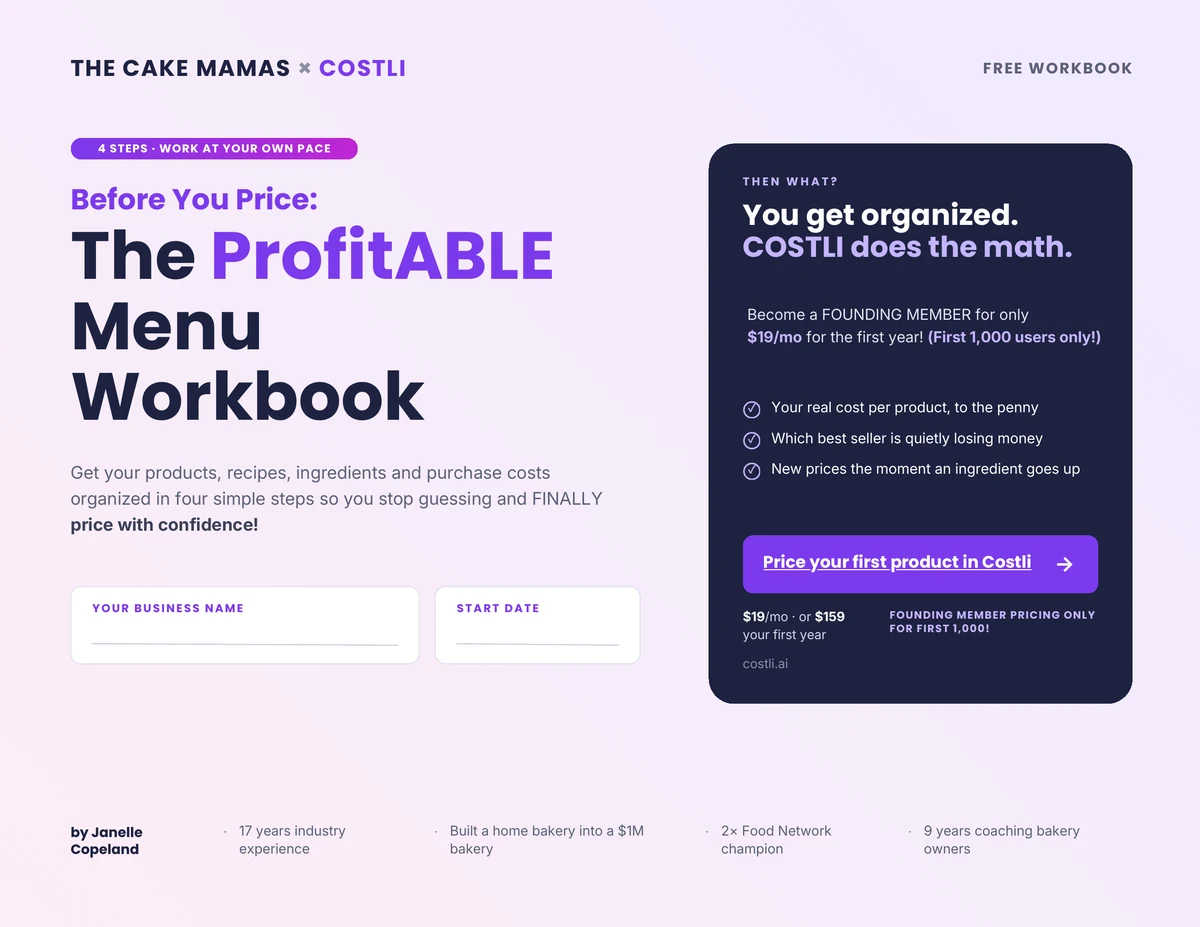
Free workbook for bakers
You know what you’re charging. But do you know what it COSTS?
Download the free ProfitABLE Menu Workbook and start organizing the products, recipes, ingredients, and costs behind what you sell.


