
How to Price Bakery Items: Start with Everything You Sell
Before you can price your bakery items, you need a list of everything you sell. Here is how to build it, category by category, in one sitting.

Quick question. If someone asked you right now to list EVERY single thing your bakery sells, could you do it?
Not just your top sellers. Not what's in your Instagram highlights. Everything. Every flavor, every filling, every seasonal item you bring back each fall.
If you had a little freak out moment just now... know you're not alone. (We've all been there.)
Here's the step most pricing advice skips: you can't price what you haven't listed. Before you touch an ingredient cost, a labor rate, or a profit margin, you need ONE accurate list of everything you sell. That list is the foundation every price gets built on.
Why pricing starts with a list (not a formula)
Most bakers start pricing their products by searching for what feels “fair” or what they’re competitors charge.
There’s a million and one problems that come along with that but most importantly… you can't accurately price your products if you haven't taken the time to figure out exactly what goes into making them.
And no pricing formula is going to fix that.
When your menu lives in your head:
- You price the products you remember and guess on the rest
- Seasonal flavors come back every year at last year's price
- Custom orders get quoted from scratch, EVERY single time
- You have no idea which products are actually making you money
Why this matters: every product missing from your list is a product you're still guessing on. And guessing is expensive af.
How to build your bakery product list
Step 1: Break what you sell into categories
Start big. What are the main TYPES of things you sell?
When Janelle Copeland, Costli's founder, ran her bakery, The Cake Mamas, the whole menu came down to four categories: cakes, cupcakes, Rice Krispie treats, and cake pops.
Yours might be bread, cookies, and pies. Or just cakes and cupcakes. Don't overcomplicate this. If you sell it, it belongs in a category.
Step 2: Split the categories that sell differently
Some categories need subcategories because they're sold in completely different ways. At The Cake Mamas, cakes split in two:
- Custom cakes: a million possible variations, quoted order by order
- Grab-and-go cakes: a set rotation of about five flavors
Custom work and ready-made products get priced differently, so give them their own space now. (Custom cake pricing is its own beast. Get the list done first.)
Step 3: List every product under its category
Now go category by category and write down everything you sell. How detailed you get depends on the category:
- Cupcakes, cookies, cake pops: list every flavor by name. Three core flavors plus seven seasonal ones? That's 10. Write down all 10.
- Cakes: list the building blocks. Every cake flavor, every filling flavor, every frosting flavor.
- Bread: every flavor and variation. If you sell sourdough, every version of it.
After 10 years in business, The Cake Mamas had 95 cupcake flavors. Your list probably isn't that long. But whatever the number is, it ALL goes on the list.
Step 4: Check it for accuracy
Go back through one more time. The seasonal flavors? The specials you still say yes to? The thing you only make for that one regular customer?
If you'd make it and take money for it, it's on the list.
What your list tells you (before you price a thing)
Once it's all written down, you'll probably notice a few things:
- Your menu is bigger than you thought
- A few "simple" products are hiding a LOT of components
- Some items you rarely make are still technically on the menu
Don't freak out. That's not a problem, it's information. And it's the difference between pricing every item you sell down to the penny and pricing the five you happen to remember.
What comes next
Your product list tells you WHAT you sell. The next step is figuring out what it takes to MAKE each one: the recipes behind every product. That's exactly what we cover in How to Standardize Recipes for Your Bakery Before You Price.
Once your products and recipes are on paper, you're ready to price with real numbers. Our guide on how to price baked goods for profit walks you through the math.
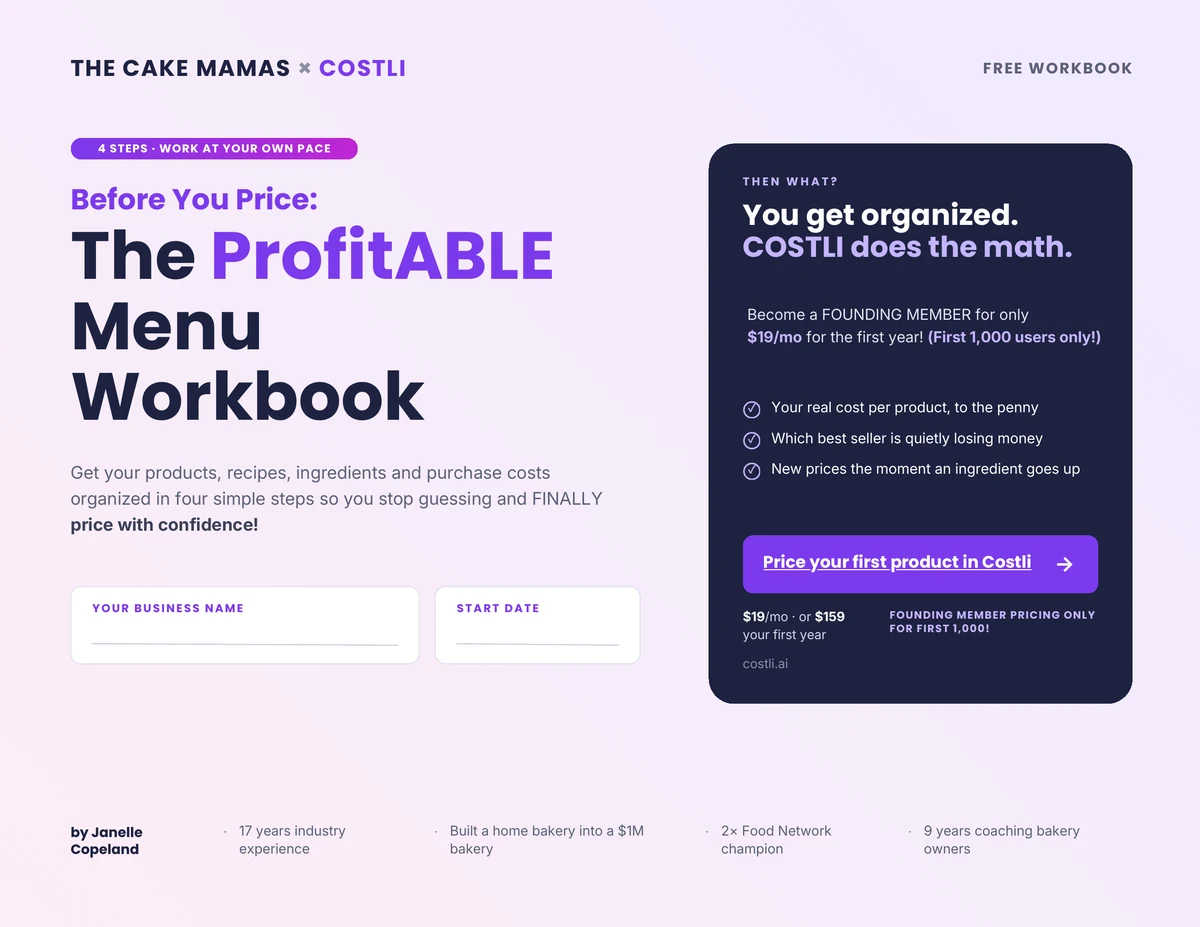
Get the free ProfitABLE Menu Workbook
Don't build this from a blank page. Before You Price: The ProfitABLE Menu Workbook gets your products, recipes, ingredients, and what you actually pay for them out of your head and onto paper in four simple steps.
Step 1 is exactly what you just read, with Janelle's full Cake Mamas list as the example and blank pages ready for yours. Drop your name and email and we'll send it straight to your inbox.
-Team Costli
Free workbook for bakers
You know what you’re charging. But do you know what it COSTS?
Download the free ProfitABLE Menu Workbook and start organizing the products, recipes, ingredients, and costs behind what you sell.


