
How to Price Cookies for Profit: The $5,000 Mistake Hiding in Your Cookie Box
Same $1,428 in sales, $421 less profit. See what 12 cookie flavors really cost and how to price cookies and bundles for profit.

98 out of 112 bakery owners are making the SAME pricing mistake. And depending on what they're selling, it could be costing them thousands of dollars a year.
The culprit? That innocent little button in their POS system that says something like "3 Cookies for $12."
Yep. THAT one.
During a recent Costli Q&A, our co-founder, Janelle Copeland, shared something interesting about the way bakery owners are pricing and tracking their products.
Of the 112 bakery owners she surveyed, 98 reported making the same type of mistake.
And when we started looking at what that mistake could actually COST them? Well, the math wasn't pretty.
Here's what happens.
You spend WEEKS perfecting your cookie menu. You've got your classics like chocolate chip and sugar cookies, but you've also got your fancy, gourmet flavors. The stuffed cookies, the cookie butter, the white chocolate raspberry that costs a small fortune in ingredients.
And then, when it's time to put everything on your menu, you decide to keep things simple.
3 cookies for $12. Six for $22. A dozen for $40.
Sounds reasonable, right?
Except there's one little problem.
Those cookies don't all cost the same amount to make. So why are we treating them like they do?
And if you're charging the same price regardless of which flavors customers choose, your profit could look VERY different from one order to the next.
Your POS knows what you sold. But does it know what you MADE?
Let's say your bakery sells 119 three-packs of cookies this month at $12 each.
Your POS reports $1,428 in revenue.
Sounds amazing, right?
But how much of that money did you actually KEEP?
Because if every single order is being rung up under the same generic "3 Cookies for $12" button, your sales report may not tell you which flavors your customers bought.
And that's a problem.
Maybe everyone bought chocolate chip cookies. Maybe they loaded up their boxes with your most expensive flavors. Maybe it was a little of everything.
If you're not tracking what customers actually bought, you're missing a HUGE piece of the profitability puzzle.
Think about it.
How do you know which flavors are your bestsellers if your POS only tells you how many three-packs you sold?
How do you know which products to make more of next weekend?
And more importantly, how do you know what those sales actually COST your business?
Spoiler: You don't.
Your POS can tell you how much revenue came through. But unless you're tracking your individual products and their costs, that revenue number doesn't tell you how profitable those sales were.
And trust us, there's a BIG difference.
Same $1,428 in sales. Two VERY different profit margins.
Let's put some actual numbers behind this.
Imagine two months at your bakery. In both months, you sell 119 three-packs of cookies for $12 each.
That's 357 cookies and $1,428 in revenue.
Your POS reports would look exactly the same if every order went through that one generic button.
But let's look at what's happening behind the scenes.
MONTH 1: Your customers mostly buy lower-cost flavors.
Let's say your average cost per cookie is $1.88, including ingredients, packaging, labor, and overhead.
- Revenue: $1,428
- Total production costs: $671.16
- Profit after those costs: $756.84
- Profit margin: 53%
Not bad!
MONTH 2: Your customers mostly buy premium flavors.
Now we're talking loaded cookies, expensive fillings, extra toppings, and all the fancy stuff.
Your average cost per cookie jumps to $3.06.
You still sell 357 cookies. You still bring in $1,428.
But now?
- Revenue: $1,428
- Total production costs: $1,092.42
- Profit after those costs: $335.58
- Profit margin: 23.5%
That's $421.26 LESS in profit in a single month.
And if that difference continued for 12 months?
We're talking about $5,055.12 in potential annual profit difference.
From ONE menu button.
Same number of orders. Same selling price. Same revenue.
Completely different profitability.
And the kicker?
If you're only looking at those generic POS sales reports, you'd have no way of knowing which month was which.
These are illustrative scenarios comparing different product costs, not verified losses from the surveyed bakeries. Profit figures subtract the stated production costs; actual net profit may differ.
Let's look at what each cookie ACTUALLY costs.
We priced out twelve different 5 oz gourmet cookies using Costli to show you how much profitability can change from one flavor to the next.
Same cookie size. Same bundle prices. VERY different costs.
And when you see these numbers side by side, you'll understand why we're making such a big deal out of that one little POS button.
Take a look.

(Example costs include ingredients based on Walmart pricing, packaging, labor, and overhead. Actual costs will vary by bakery.)
First, look at the Sugar Cookie.
It costs $1.70 to produce. If you're selling it in your 3-for-$12 bundle, you’re making $2.30 per cookie after costs.
Now look at White Chocolate Raspberry.
That cookie costs $3.69 to produce.
Same $4 selling price, but you're only making $0.31 per cookie.
And if someone buys a dozen at $40?
Well, now we're in trouble. Because that bundle works out to approximately $3.33 per cookie.
And your White Chocolate Raspberry costs $3.69 to make. You're LOSING $0.36 on every White Chocolate Raspberry cookie sold at that price.
Not earning a smaller margin. Actually selling it for LESS than it costs to produce.
And she's not the only cookie worth looking at.
Your PB Cup costs $2.75. Your Cinnamon Bun costs $2.76. Your Pumpkin Latte costs $2.77.
So even though all three sell for the same amount, you're making significantly less on them than you are on the sugar cookies.
Then there's Thin Mint, which costs $3.05 and earns just $0.28 per cookie in a dozen box.
That's a LOT of work for 28 cents.
And remember, these are all the same size cookies!
Your bestselling flavor might be the one making you the LEAST amount of money.
Now imagine that White Chocolate Raspberry happens to be your most popular flavor.
Customers request it every weekend. They buy it by the dozen. You keep making more because, according to your sales, business is BOOMING.
Except the more of those cookies you sell at that dozen-box price, the more money you're losing.
And if your POS only records "12 Cookies for $40," you might never even realize how many you're selling.
This is why tracking individual products and knowing their costs is SO important.
Because POPULAR doesn't always mean PROFITABLE.
So, are bakery bundles a bad idea?
Absolutely not.
We're not about to tell you to stop selling cookie boxes, cupcake packs, or dessert bundles. Bundles can be a GREAT way to increase order value and make buying easier for customers.
And no, you don't necessarily need 47 different buttons in your POS system, either.
But you DO need to know what those products cost before you decide what to charge for them.
Because a bundle isn't automatically profitable just because the price sounds like a good deal.
And charging the same amount for products with completely different costs?
That's a pricing decision you need to make with your numbers, not your feelings.
Remember: Your price is not a feeling. Your price has a job.
Here's how to make sure it's doing that job.
How to price bakery products and bundles for profit
1. Know what EACH product actually costs
Before you start creating bundle deals, you need to know what goes into making every product on your menu. Not just your ingredients. We're talking packaging, labor, overhead, toppings, fillings, decorations... ALL OF IT.
Because that drizzle of chocolate, the half an Oreo, and the fancy box aren't free. And they're definitely not getting any cheaper.
Inside Costli, you can organize the ingredients you buy, build your recipes, and calculate the cost of your finished products.
So instead of assuming your chocolate chip and white chocolate raspberry cookies cost roughly the same, you can see exactly where the difference is.
And once you know that? You can make pricing decisions that actually make sense.
2. Track what you're ACTUALLY selling
If your sales report says you sold 119 three-packs, that's useful information. But it's not the whole picture.
You also need to know which flavors were inside those boxes.
Are your customers buying mostly classics? Are they buying a mix? Is one expensive flavor accounting for half your sales?
Because those answers matter.
If your POS supports individual products or flavor modifiers, use them to track your sales more accurately. And if you're a home baker who doesn't even HAVE a POS yet? Start tracking the products you sell now.
Seriously.
You don't need to wait until you've got a storefront and a fancy POS system to start building better business habits.
Bad habits don't magically disappear when your business grows. They just get more expensive.
Costli gives you a place to organize your products, so you can start building those habits BEFORE you're juggling a storefront, employees, and hundreds of weekly orders.
3. Check the profitability of your bundles BEFORE putting them on the menu
Now that you know what your individual products cost, it's time to look at your bundle pricing.
Let's go back to those cookies.
Maybe your classic cookies can comfortably sell for three for $12.
But your premium flavors need to be three for $15.
Or maybe you create two different options:
- Classic Cookie Box: Chocolate chip, sugar, oatmeal raisin, and other lower-cost flavors.
- Premium Cookie Box: Stuffed cookie butter, loaded cookies, white chocolate raspberry, and other higher-cost flavors.
The actual prices will depend on your costs and desired margins.
The point is that you're no longer throwing a number on your menu and HOPING it works.
You're building prices around what your products actually cost. And with Costli, you can calculate the costs of your products and bundles before deciding what to charge.
Because finding out you're losing money AFTER you've sold 200 cookie boxes? Not exactly the kind of surprise we're going for.
Your sales might look good. But what do your profits look like?
Here's the thing.
You can sell hundreds of cookies every weekend. You can have a line out the door, a sold-out menu, and customers who absolutely LOVE your products.
But none of that guarantees you're making money.
And if you're not tracking the products you're selling or calculating what they actually cost, you could be making a whole lot LESS than you think.
Remember those 119 cookie orders?
The same $1,428 in sales produced a difference of more than $421 in monthly profit, just because the product costs changed.
Imagine what that could mean across an entire menu of cookies, cakes, cupcakes, dessert boxes, and custom orders.
That's why knowing your numbers matters.
Not because we want you spending your weekends buried in spreadsheets.
Because we want you building a business that can actually afford to GROW.
Revenue isn't the flex you think it is. PROFIT is.
So before you add another bundle deal or create another menu button, find out what your products really cost. Your future bank account will thank you.
Stop guessing what your bakery is making.
Costli helps you organize your ingredients and recipes, calculate your product costs, price your bundles, and get a clearer picture of your bakery's profitability.
No more pricing by vibes. No more wondering whether that bestseller is actually making you money.
Get started with Costli at costli.ai
Know your costs. Grow your profits.
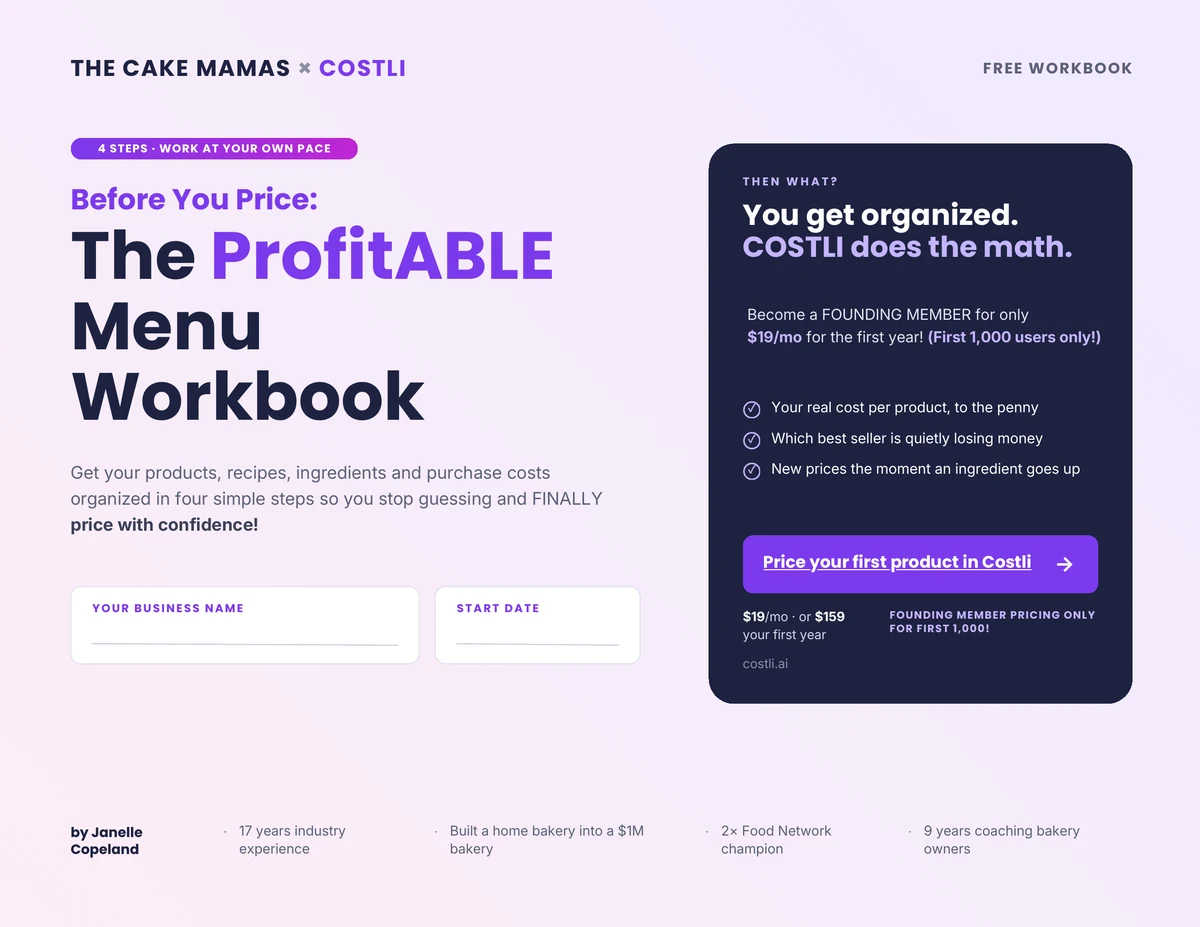
Free workbook for bakers
You know what you’re charging. But do you know what it COSTS?
Download the free ProfitABLE Menu Workbook and start organizing the products, recipes, ingredients, and costs behind what you sell.


