
How to Organize Your Bakery Recipes So You Can Price Them
Learn how to organize your bakery recipes so you can actually price your products: break each product into its recipes and write each one down once.

Quick question: If someone asked you for the EXACT recipe for your bestselling cupcake right now, could you hand it over?
Not the Pinterest recipe you started with three years ago. Not the version you have memorized because you've made it 400 times but the ACTUAL recipe you use on a daily basis.
With the exact ingredients, measurements, HOW MUCH it makes…TODAY.
Or would you need to piece it together from your Notes app, an old recipe binder, and a few measurements you just know by heart?
For a lot of bakers, it’s the latter.
And while that system might work when you're the only person in your business, it creates a pretty big problem when you're trying to figure out what your products actually cost to make.
Before you can accurately price your baked goods, you need to know exactly what goes into them. And that starts with getting your recipes organized.
Before we dive in, let's clear something up: Recipes and products are NOT the same thing.
They're related, obviously. But there's an important difference.
A recipe is what you MAKE. A product is what you SELL.
Take a chocolate chip cookie, for example. If you're selling a classic chocolate chip cookie, you might only need one recipe to make that product.
Simple enough.
But what about a chocolate cupcake filled with caramel, topped with chocolate buttercream, and finished with a caramel drizzle?
That's a whole different situation.
You're not just making a cupcake. You're making several different components that come together to create ONE product.
And every single one of those components costs money.
Let's use a REAL bakery example.
When Janelle Copeland owned The Cake Mamas, one of the cupcakes on the menu was a chocolate salted caramel cupcake.
Sounds pretty straightforward, right?
Well, here's what actually went into making it:
- Chocolate cupcake base: The actual cake.
- Chocolate ganache: Made separately and used in the buttercream.
- Chocolate buttercream: Its own recipe, made using that ganache.
- Caramel filling: The thick caramel inside the cupcake.
- Caramel drizzle: The finishing touch on top.
That's FIVE different recipes involved in making one cupcake.
Now imagine trying to figure out how much that cupcake costs to produce when you've only calculated the cost of the chocolate cake batter.
What about the chocolate ganache? The buttercream? The caramel?
Those ingredients didn't magically become free just because they're not part of the cupcake base.
If you're not accounting for every single recipe that goes into your finished product, you're not working with the full cost.
And when your costs are incomplete, your prices can be, too.
We actually break down how to calculate all those individual components in How to Cost a Recipe with Filling, Frosting and Toppings.
One other thing worth noting: Sometimes one recipe is used to make another recipe.
Remember that chocolate ganache? It's an ingredient in the chocolate buttercream.
This is exactly why Costli allows you to build recipes using other recipes. You can calculate the ganache once and then use it as a component of your buttercream instead of having to figure out those costs from scratch.
Because who wants to do the same math over and over again? Not us!
So, what exactly is a standardized recipe?
It's a fancy way of saying you have a recipe that's actually written down and repeatable.
Same ingredients. Same measurements. Same process. Same yield.
It’s all about consistency and documentation.
Think about it this way: If you hired someone tomorrow to help with production, could they make your bestselling cookies without you standing over their shoulder?
If the answer is no, your recipes probably aren't as organized as they need to be.
And that matters for more than just pricing.
When your recipes only exist in your head, YOU become the instruction manual for your entire bakery.
Want to hire help? They need you.
Want to take a day off? They need you.
Want someone else to handle production while you focus on running the business?
You get the idea.
Documenting your recipes is one of the first steps toward building a bakery that doesn't require you to be IN it 24/7.
What should you include in a standardized bakery recipe?
You don't need anything complicated. But you DO need enough information for someone else to recreate the recipe accurately.
Here's what that includes:
- Every ingredient. Yes, even the teaspoon of vanilla, pinch of salt, or espresso powder you add to your chocolate cake.
- Exact measurements. Ideally by weight, especially when it comes to ingredients like flour, sugar, and butter. Here's why accurate ingredient measurements matter when calculating costs.
- The finished yield. Does the recipe make 12 cupcakes? 24 cookies? Four cups of buttercream? Write it down.
- The instructions. The actual steps someone would need to follow to make it correctly.
And please don't skip the yield.
Because knowing that your chocolate cupcake batter costs $18 to make doesn't tell you much about the cost of ONE cupcake until you know how many cupcakes that batter produces.
If your $18 batch makes 24 cupcakes, your base cost is $0.75 per cupcake.
If it only makes 12? That jumps to $1.50.
Same batch cost. VERY different cost per cupcake.
And remember, that's before you add the frosting, fillings, packaging, labor, and other expenses involved in selling it.
Here's how to start organizing your bakery recipes.
Before you open another spreadsheet or start rewriting every recipe you've ever made, we want you to do something much simpler.
Figure out what recipes you actually NEED.
Step 1: Start with your product list.
Grab a list of everything you currently sell.
Not just your bestsellers. Everything that's actively available for customers to purchase.
If you haven't put that list together yet, start with our guide on How to Price Bakery Items: Start With Everything You Sell.
Step 2: Break each product into its individual recipes.
Using your product list, write down every recipe required to make each finished product.
Think cake bases, cookie doughs, buttercreams, fillings, glazes, ganache, and sauces.
Don't forget the little things.
That homemade caramel drizzle you put on six different products? It counts.
The cream cheese frosting you use for your cinnamon rolls AND your carrot cake? Also counts.
Step 3: Create ONE master recipe list.
Here's where things start getting easier.
You do NOT need to document your vanilla buttercream six different times just because you use it in six different products.
You only need one standardized recipe for that buttercream.
So, as you're working through your products, start building a master list of the unique recipes you use.
You'll probably be surprised by how much overlap there is.
A bakery might have 30 products on its menu but use the same handful of cake bases, frostings, fillings, and cookie doughs across several of them.
Step 4: Figure out what's documented and what isn't.
Now look at your master recipe list.
Which recipes do you already have written down with accurate measurements and yields?
Which ones are still living in your head?
Document them accordingly.
That's it. Now you have a clear picture of what needs your attention instead of randomly organizing recipes and hoping you haven't forgotten anything.
And NO, you don't need to organize your entire bakery in one day.
If you have 50 products on your menu, we are absolutely NOT suggesting you spend the next 14 hours rewriting every recipe you've ever made.
Start with your top three products in each category.
Figure out which recipes go into those products, document the ones you're missing, and work your way through the rest of your menu.
You'll make progress without turning a necessary business task into a three-week project you never finish.
Want a head start? We made you a workbook.
If you're realizing that half your recipes live in your head and the other half are scattered between notebooks, screenshots, and your phone, we've got something for you.
Our FREE Before You Price: The ProfitABLE Menu Workbook helps you organize the information you need before you start calculating your product costs.
Step 2 includes two worksheets specifically for organizing your recipes.
One helps you break down your products into all the individual recipes required to make them. The other helps you build a master recipe list, so you can see exactly what you've already documented and what still needs work.
And here's the best part: The workbook follows the same organizational structure used in Costli, so you're setting yourself up to enter your information into the platform when you're ready.
No fancy systems required. Just a clear place to start.
Get Your FREE ProfitABLE Menu Workbook →
— Team Costli
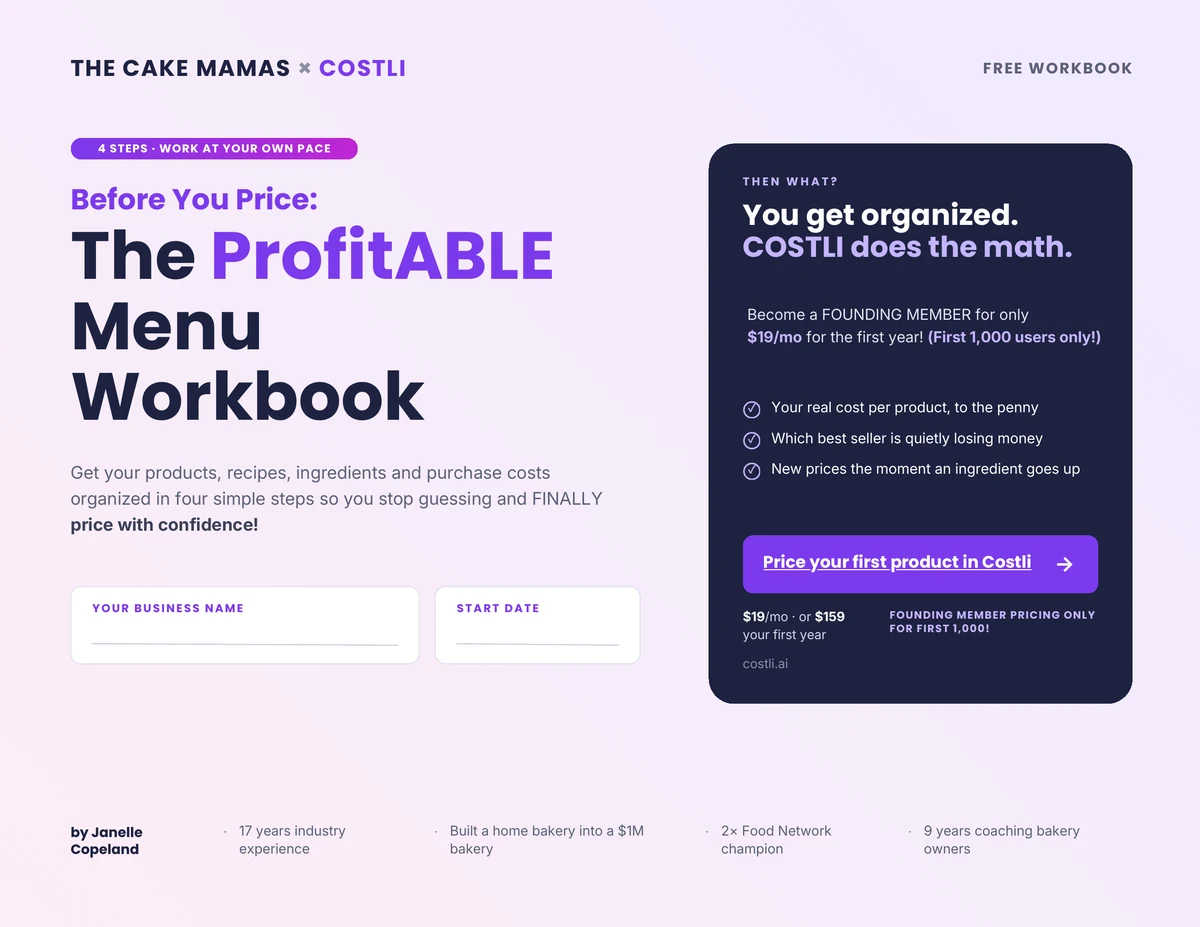
Free workbook for bakers
You know what you’re charging. But do you know what it COSTS?
Download the free ProfitABLE Menu Workbook and start organizing the products, recipes, ingredients, and costs behind what you sell.


